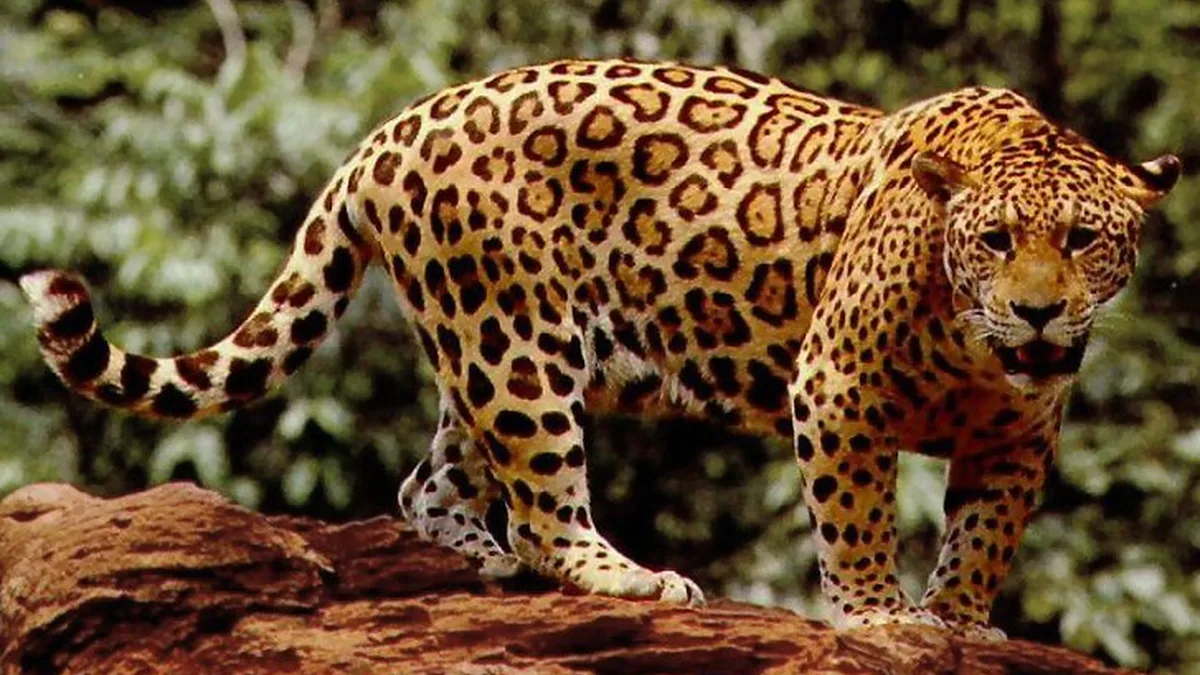
Jaguar
| Country of origin | Americas |
|---|---|
| First documented | Prehistoric (Pleistocene epoch) |
| Original use | Apex predator in neotropical ecosystems |
| Conservation status | Near Threatened (IUCN Red List) |
| Primary threat | Habitat loss and fragmentation |
| Human intervention benefit | Direct protection and corridor creation are beneficial; reintroduction programs have mixed results |
| Current range | From northern Mexico through Central America to northern Argentina |
Origin and history
The jaguar (*Panthera onca*) is a large felid species native to the Americas, with its evolutionary lineage tracing back to the Pleistocene epoch. Its ancestors likely crossed into North America from Asia via the Bering Land Bridge during the late Pliocene or early Pleistocene, over two million years ago. The modern jaguar's range historically extended from the southwestern United States through Central America and into much of South America, reaching as far south as northern Argentina. Fossil records indicate jaguars once shared territory with other now-extinct megafauna like giant ground sloths. The species has held significant cultural and spiritual importance for numerous indigenous civilizations across this range for millennia, featuring prominently in Olmec, Maya, and Aztec iconography. Its current range has been drastically reduced, primarily due to human activity over the last two centuries.
What it was bred for
The jaguar is a wild species and was not selectively bred by humans for a specific purpose, as it is not a domesticated animal. Historically, its formidable strength and elusive nature led to its symbolic "use" as a representation of power and royalty in pre-Columbian Mesoamerican cultures, where it was often associated with rulers and deities. In some indigenous societies, jaguar pelts were used as ceremonial garments by shamans and warriors to embody the animal's perceived attributes. Unlike domesticated cats, jaguars have never been bred for companionship, labor, or aesthetic traits. The concept of breeding jaguars applies only to modern captive populations in zoos and breeding centers, where the goal is genetic management for conservation, not the alteration of the species for human utility. Any captive breeding aims to preserve the genetic diversity and inherent biological characteristics of the wild population.
Life cycle
Female jaguars typically reach sexual maturity around two to three years of age, while males mature slightly later. Mating can occur year-round, and after a gestation period of approximately 90 to 110 days, a litter of one to four cubs is born in a secluded den. The cubs are born blind and completely dependent, opening their eyes after about two weeks and beginning to eat solid food after six to eight weeks. They remain with their mother for a substantial period, often up to two years, learning essential hunting and survival skills before dispersing to establish their own territories. In the wild, a jaguar's lifespan is estimated to be between 12 and 15 years, though this can be shorter due to conflict with humans or other factors. In captivity, with veterinary care and consistent nutrition, jaguars may live into their early twenties.
Character and appearance
The jaguar is the largest cat species in the Americas and the third-largest big cat globally, characterized by a robust, muscular build and a broad head with powerful jaws. Its most distinctive feature is its coat pattern of black rosettes, which are rose-shaped spots often with smaller dots inside, set against a background color ranging from pale yellow to reddish-brown. Melanistic individuals, commonly called black panthers, are relatively frequent in parts of its range, particularly in dense rainforests. Jaguars are solitary, territorial, and crepuscular predators, most active at dawn and dusk. They are renowned for their exceptionally powerful bite, which allows them to pierce the skulls or shells of prey like turtles and caimans, a hunting method unique among big cats. Their behavior is typically secretive and elusive, avoiding human contact where possible, and they are capable swimmers who often hunt in and around watercourses.
Pros and cons
Pros: The jaguar plays a critical role as an apex predator, regulating prey populations and maintaining the structure and health of its ecosystems, particularly rainforests and wetlands. Its presence indicates a healthy, biodiverse environment. Conservation efforts focused on the jaguar, such as creating protected corridors, often benefit countless other species that share its habitat. Ecotourism centered on jaguar viewing can provide sustainable economic incentives for local communities to preserve wild lands. The species' cultural significance remains strong, offering a living link to the natural heritage of the Americas. Successful protection of jaguar populations demonstrates the possibility of large carnivore coexistence with humans in managed landscapes. Cons: Jaguars require vast, contiguous territories, making them highly vulnerable to habitat fragmentation from agriculture, logging, and urban expansion. Human-jaguar conflict is a persistent issue, particularly in cattle-ranching regions where jaguars may prey on livestock, leading to retaliatory killings. Conservation programs sometimes face criticism when they prioritize top-down land designations without sufficient involvement or benefit for local human populations, breeding resentment. Well-intentioned interventions, like captive breeding and reintroduction, are extremely costly, logistically complex, and carry risks of disease transmission or animals failing to adapt. A common mistake is focusing solely on the jaguar as a charismatic symbol while neglecting the broader habitat protection and community engagement necessary for long-term survival. Some conservationists regret past approaches that treated the symptom (individual conflict animals) rather than the cause (habitat loss and lack of coexistence strategies).
Who it suits
The jaguar suits expansive, interconnected wild landscapes with abundant prey and minimal human disturbance, such as large protected areas in the Amazon Basin or the Pantanal wetlands. It is suited to regions where legal protection is strong and enforced, and where coexistence strategies, like compensated livestock loss and predator-proof enclosures, are implemented and accepted by local communities. The species is suited to conservation models that are multinational in scope, given its need for cross-border corridors, such as the Jaguar Corridor Initiative spanning from Mexico to Argentina. It suits the focus of experienced conservation biologists and organizations prepared for long-term, complex efforts involving habitat preservation, conflict mitigation, and scientific monitoring. The jaguar does not suit areas of intense human development, small isolated reserves, or regions lacking the political will and funding for comprehensive carnivore conservation. Ultimately, its survival suits a world that values intact ecosystems and the role of apex predators within them.